Development and Governance

Blog

  • Political Capture and Growing Disparity

    (What I feared when I wrote this in 2014, has come to pass. Geopolitics is now discussed purely in terms of the Transnational Private Sector, and deals are made to maximise wealth and power, not to minimise human suffering. )

    In the 1960s and 1970s, cold and hot wars were fought to push the idea of benevolent capitalism – believing that creation of wealth at the top of the pyramid would ‘trickle down’ and eradicate extreme poverty across the world. That did not happen.

    Since the 1990s, the mantra of globalisation has been that high rates of economic growth will greatly reduce the incidence of poverty worldwide. That has not happened either.

    In reality, the globalised world economy has deeply fragmented production processes, labour markets, political entities and societies, creating a plethora of interest groups and lobbies which have undermined the integrity of civil society and its rights and entitlements across the world. This is becoming increasingly visible in rich and poor countries in the form of growing disparity between places, people and groups. In particular, it is manifested in much greater income inequalities.

    While a small but economically powerful section are now true global citizens and look outward for direction, the majority survive day to day, with ever reducing options and choices, pushed deeper and deeper into the world they once knew, but which is fast disappearing. The centrifugal forces of the one and the centripetal forces of the other will one day tear society apart. The cracks are already beginning to show – religious extremism, communal strife, growing racism and violence against women, more conspiracy theories and paranoia, more and more right-wing governments… The sorry stuff of headlines every day, everywhere…


    An interconnected global economy has resulted not only in greater corruption and clientelism but also political capture, where the laws of the land increasingly favour the rich over the poor. (See my earlier post: The 3 Cs…)

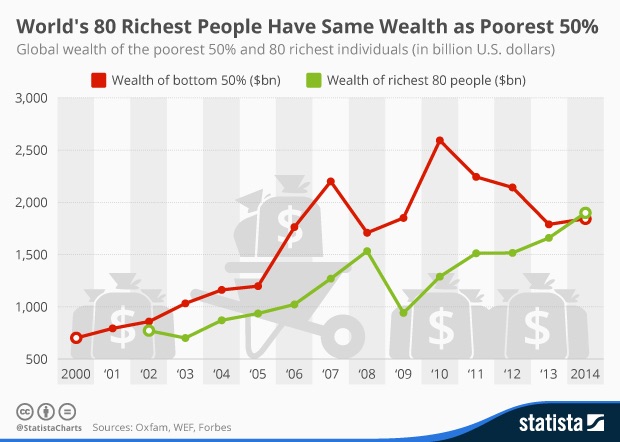
    Oxfam set the cat among the pigeons when it put out the following figures:

    • Almost half of the world’s wealth is now owned by just one percent of the population.
    • The wealth of the one percent richest people in the world amounts to $110 trillion. That’s 65 times the total wealth of the bottom half of the world’s population, which owns the same as the richest 85 people in the world.
    • Seven out of ten people live in countries where economic inequality has increased in the last 30 years.
    • The richest one percent increased their share of income in 24 out of 26 countries, for which Oxfam have data, between 1980 and 2012.
    • In the US, the wealthiest one percent captured 95 percent of post-financial crisis growth since 2009, while the bottom 90 percent became poorer.
    image

    Measuring Disparity

    The Gini Coefficient is a measure of statistical dispersion developed by the Italian statistician and sociologist Corrado Gini and published in 1912. It measures the inequality among values of a frequency distribution, for example levels of income. A Gini Coefficient of zero expresses perfect equality, where all values are the same e.g. where everyone has an exactly equal income; while a Gini coefficient of 1 expresses maximal inequality among values e.g. where only one person has all the income. Some Gini Indices are expressed as percentages, as in the chart below:
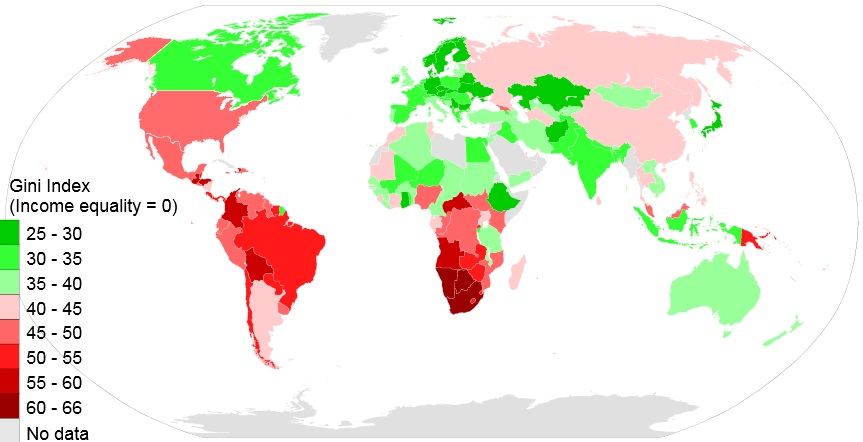
    Income_Gini_Coefficient_World_Map

    Looking at a select few countries representative of the global economy, the following picture emerges:

    Gini coefficient

    It is interesting to note that out of the BRICS countries in the above graph, South Africa demonstrates the highest inequality of incomes, perhaps a reflection of its largely natural resource based economy (gold and diamonds), which has traditionally been developed by a rich white minority during the long years of apartheid.

    Brazil too has a long history of military juntas which allowed a class of the super-rich with immense land holdings to flourish. It is only recently, that concerns of the poor have moved centrestage in Brazilian politics, and with the re-election of President Rousseff, are likely to remain there.

    The growing disparity in China is indeed a surprise, especially because it is the last surviving communist regime of any consequence in the world. Perhaps the unnaturally rapid urbanisation and industrialisation in a traditionally agrarian society has allowed individual entrepreneurs to accumulate immense fortunes in a relatively short period of time.

    The majority of the countries in the world have a Gini coefficient between 0.3 and 0.4. In the case of developing countries like India and Egypt, it is a reflection of the growing middle class post-globalisation; while in the case of USA and UK, it is a testament to their relatively secure health and income safety nets, which prevent extreme deprivation and hardship in the population.

    News just in: A Credit Suisse Report says that disparity is growing rapidly in India, with the top 10% now holding 74% of the country’s total wealth, while the bottom 10% hold just 0.2%. The share of the top 1% (nearly half the country’s wealth) has always been lower than the share of the global 1%, but is now growing faster than the rest of the world. Yet Indians make up nearly 20% of the world’s poorest 10%!

    Not surprisingly, Sweden repeatedly tops the charts for both highest Human Development and lowest disparity, clearly demonstrating the inverse relationship between disparity and human well-being.

    Oxfam recommends that governments wishing to reduce the income disparity in their countries as a means of tackling poverty should consider:

    • Cracking down on financial secrecy and tax dodging
    • Redistributive transfers and strengthening of social protection schemes
    • Investment in universal access to healthcare and education
    • Progressive taxation
    • Strengthening wage floors and worker rights
    • Removing the barriers to equal rights and opportunities for women

    Going by the experience and the professed policies of the new government in India, is any of this likely to happen soon? I think not.

    Maybe after 5 years, the most tangible legacy of this government will be an India with a higher Gini coefficient.

    And that may get the voters rethinking the promised ‘good times’…

  • Independence Day 2025

    The 15th of August marks the day that India achieved its independence from Britain in 1947. It has indeed kept its tryst with destiny in many areas like poverty alleviation, health, infrastructure and education, but never in its 78 years has it looked so weakened and at the mercy of other countries, as it does today.

    Independence? What independence?

    Four years ago, Afghanistan was liberated from the 20-year American occupation and got Independence on 15 August 2021. Since then it has seen massive investments (and therefore, control) by China in its three main areas of interest: security (against separatists), connectivity (access to Central Asia for its Belt and Road Initiative) and Mining. In fact it is now as vassalised by China as Pakistan. 

    Independence? What independence?

    By a curious irony, on 15 August 2025, the world sees a summit meeting of its two most belligerent power blocs, at Anchorage, Alaska. This meeting between the leaders of Russia and the United States has been designated by some observers as Yalta 2.0. The original Yalta Summit of 1945, ended up carving post-war Europe between the West and the Soviet Union, and this time it is expected that Ukraine will be similarly divided between a victorious Russia and giant corporate conglomerates of the West. 

    Somewhere along the way the sanctions against Russian oil will be lifted or diluted and there will be India, hat in hand, hoping that it is spared the punitive 50% tariffs for breaking the original sanctions on Russian oil. India’s position is morally weakened by the fact that the chief beneficiary of this ill-advised oil import was not the Government of India, nor the Indian consumer, but the private refineries who re-exported this oil to Europe. And to think that in the heyday of the Non-Aligned Movement, India was the world’s conscience!

    Independence? What independence?

    However, the longest-term damage that India has inflicted on itself is the total subjugation of its intellectual capital to western systems and frameworks whether in classic research and development, or the emerging IT and AI sectors. It is no surprise that NOT ONE of the 20 globally most used apps and software was created in India. The resulting drain of expertise created and subsidised by Indian taxpayers to the West, and chiefly the USA, has not only debilitated our human resources, but also given these countries more leverage on Indian foreign policy by weaponising things like the H-1B visa.

    Independence? What independence?

    Ironically the only truly independent country in the world today is that much maligned autocratic monolith – China. But they have always preferred to use the word ‘self dependent’ instead of independent, and that should also be India’s path ahead: Self reliance as already denoted by ‘swadheen’ on this Swadheenta Divas.

    Jai Hind!

  • Republic Day 2025: Governance or Politics?

    The Constitution of India, which is celebrated every year on the 26th of January as Republic Day, does three things: 

    ·      Firstly, it puts the people of India and the public good CENTERSTAGE in all government policy

    ·      Secondly, it delineates the moral framework for the government’s functioning, by asserting its faith in the universal values of liberty, equality, and fraternity

    ·      Thirdly it provides a template for good governance, ensuring efficiency, effectiveness, participation, accountability, responsiveness, transparency, inclusion, equity and rule of law in the day to day functioning of government and its various institutions, while encouraging all policy making and legislation to be through a consensus negotiated and arrived at by the country’s Elected Representatives

    I have made Republic Day the occasion on which I take a look at issues of governance in the country, and this time I am appalled to find that governance in its fullest sense has virtually disappeared from the Indian scene and been replaced by politics.

    When governance becomes pure politics the country is in trouble. Let me explain. 

    As outlined in the Constitution, one of the key roles of any government is to ensure equality and fraternity by enabling the DEVELOPMENT of the people in every sense of the word – by providing them with education, livelihoods, housing, health care, infrastructure, services and social security. However, when this aspect of governance is reduced to politics, we witness the unedifying spectacle of all political parties literally buying votes with tax-payers’ money by promising ever growing and increasingly unsustainable freebies before every election. As the intended beneficiaries are also the largest voter block, the party that ‘promises’ the most manages to win the election. They are feeding the poor for a day by giving them a fish (politics) and not feeding them for a lifetime by teaching them how to fish (governance). 

    If this is the politicisation of governance at the bottom level, there is an equally pernicious process happening at the top – not just in India, but globally as well. What commentators call the OCGFC (Owners and Controllers of Global Financialized Capital) are increasingly deciding the domestic and foreign policy across the world, and as the largest benefactors of political parties, the OCGFC inevitably politicise international relations.

    India won the respect of both superpowers, USA and the Soviet Union,  as a founding member of the Non-Aligned Movement (NAM) which oversaw the demise of the Colonial era, and kept India out of the conflicts of the Cold War era, allowing it to work exclusively for the public good of its vast, impoverished population.  However, post-liberalisation, India has witnessed not only the privatisation of its public assets but also of its policy and decision making. Instead of non-alignment India’s foreign policy in recent years has literally fallen between two stools, precisely because it chose to protect private interests at the cost of public ones.

    ·      First, it allowed private companies to bypass the sanctions imposed by the West after the Ukraine conflict, and import vast quantities of Russian oil. (News item: Russia’s Rosneft has pledged to supply private Indian refiner Reliance with about half a million barrels of crude a day. At today’s prices, this will generate $13 billion annually for Russia). This naturally upset the US and its allies. 

    ·      Second, the ruling party in India has been vehement in its support of Israel (despite the growing distaste for its genocidal policies across the world), partly to protect the investments of another capitalist crony in Israel’s weapons and industry and port infrastructure, and partly for ideological reasons. This has thoroughly alienated India in the global South and among Arab and Muslim civil societies worldwide. In fact, India has never been so utterly marginalised in the international community as now, and even in BRICS+, of which India was a founding member, the letter ‘I’ has increasingly come to stand for Iran, rather than India. What a shame!

    *                    *                 *

    However bleak the outlook, I have great faith in the will of the Indian people, and feel that the situation is still redeemable if: both the Government and Opposition get out of their perpetual Election mode; Policy making insists on consensus rather than the confrontation that is the staple of the Indian Parliament today; and the much delayed National Census is conducted ASAP to enable informed decision-making and planning for the larger public good.  

  • Independence Day 2024: The freedom to choose

    Every year, the 15th of August marks the coming into being of the sovereign, independent nation state of India – the day in 1947, when India was at last free from the oppressive yoke of British Colonialism and subservience of the last 2 centuries. In Hindi, we officially translate Independence as Swatantrata or ‘Self-empowerment’, or colloquially as Azadi or ‘freedom’.

    I like to think of it as our Freedom Day.

    When we were given that greatest of Freedoms – the Freedom of Choice. To choose our way forward. To choose our way of Government. To choose the framework of values by which we would govern ourselves. To choose our path to Justice for All. To choose the mechanisms, institutions and means to achieve our national ideals. To choose our economic policies. To choose the path to equity and inclusion. To choose how to create a level playing field. To choose our leaders. And most importantly, to choose to change those leaders every now and then, if they did not achieve our national goals, or live up to our expectations.

    As happened almost everywhere, newly independent states tended to adopt the laws, institutions and mechanisms of governance from their erstwhile colonial masters, and India too, chose the path of a Westminster style bicameral Parliamentary democracy, underpinned by a remarkably well thought out Constitution, with elections every five years, where people had the freedom of choice to elect their representatives.

    The first few years were quite exhilarating and challenging, as the largely illiterate and rural ‘population’ learnt of their rights and freedoms and exercised their choices as ‘citizens’ of a free and sovereign nation-state. Slowly and surely, democracy took root and thrived in India, while it floundered badly through coups and military rule in several of our neighbouring countries.

    However, as technology connected the world, we have seen the consolidation of power, wealth, and influence in an increasingly tiny but interconnected minority. There is talk of the ‘capture’ of national economies and evidence of ‘crony capitalism’ across the world. Oligarchs are thriving and public interest has been replaced by ‘special interest’ groups and lobbies. Social media has unleashed unprecedented connectivity, and conspiracy theories of machinations and manipulation thrive. In fact, the dreaded ‘Deep State’ was mentioned for the first time in the Indian Parliament by the Leader of the Opposition. Lately, this too is being replaced with a more contemporary phrase: Owners and Controllers of Global Financialized Capital or OCGFC, who are credited with cornering all the world’s wealth and resources, have no particular ideology or moral compass of their own, and use Think Tanks and NGOs to disguise their single-minded pursuit of wealth accumulation.

    These theories are indeed manifest in a lot of cases, though not universally. There is no doubt that unbridled liberalisation, privatisation, and globalisation has greatly weakened all democracies at the grassroots level. For instance, with the rapid privatisation of public assets and the subsequent decimation of the Trade Unions, the British Labour Party was reduced to a shadow of its former self and the average Brit has more or less lost his freedom of choice, as all he has to choose from, is the greater and lesser evil in any given election year.

    The most ridiculous travesty of democracy is of course, visible in the US, where the choice of the people is circumscribed by who shows great and greater enthusiasm for a tiny settlement colony thousands of miles away, which uses the American tax-payers’ money to buy up politicians from both parties, who then obediently go on to sanction more aid – and so the vicious circle continues… As someone famously said :   “This system was not built in a way that allows us to vote our way out of imperialism, colonialism and genocide. If it was, we wouldn’t have been given the right to vote. If the ruling class knew that voting can actually make a difference, they wouldn’t be encouraging it.” So much for Freedom of Choice.

    In India too, we find that institutions are being replaced by agencies; administration with expediency; policy by special interests; and governance by politics – while national assets are being sold to the highest bidder and national culture (and identity) gets eroded by exploitative sponsorship. The power of a handful of big businesses is destroying years of effort for a more just and equitable society, and with the rising costs of education in the burgeoning private sector (at the cost of grossly under-resourced public education), the country is well on its way to losing its demographic dividend.

    So this Freedom Day, let us restore a real freedom of choice for the Indian citizen. Let the diversity of precept and practice that was our hallmark be revived. Let a variety of ideologies bloom in this desert of amoral opportunism. Let it again become fashionable to speak up for the people of India.


    Jai Hind!

  • Republic Day 2024 : A Requiem? 

    The Republic Day is celebrated in India every 26th January to mark the day that the Constitution that “We, the People of India” gave to ourselves, took effect.

    There is a very clear and present danger that by the time I get to write this post in 2025, the soul of the Indian Constitution will have been irrevocably lost through the removal of the adjectives SOCIALIST and SECULAR from the Preamble, and this post would become a sort of Requiem.

    Although these two words were not specifically written down in the first Constitution, the sprit that informed the writers of that document, subsumed these concepts in the two words it did mention – EQUALITY and FRATERNITY. No doubt inspired by the French Revolution, which the Western educated elite that wrote the Constitution, probably found to be universally acceptable and noncontroversial.

    It was probably the realisation that both these aspirations were still far from the country’s reach two decades after Independence, that forced the then Government, to take advantage of the curtailed democracy during the Emergency, to amend the Constitution and insert the words SOCIALIST and SECULAR in its Preamble. 

    So why was India not able to achieve greater equality despite adopting overtly socialist policies in the first few decades after Independence? The chief historical reason is that India could never crush the old feudal system riddled with centuries of caste and class-based inequality, as the other Asian giants could: Japan after its defeat in WW2, South Korea after a bloody war and the subsequent division of that country, and China through the violent and messy Cultural Revolution. 

    Moreover, in rebuilding their societies, these three countries chose education as the chief vehicle of social change, and all adopted the two-pronged approach of UNIVERSALISATION of education, and VOCATIONALISATION of Higher Education. India failed to do so despite a visionary like Pandit Nehru at its helm. Instead, we went in for the creation of elite (emphasis added) institutions like the IITs and IIMs, for the self-styled ‘elite’ or entitled class, which had monopolized knowledge for millennia – rather like the Scribes of Ancient Egypt. 

    So, when the era of global trade and connectivity dawned, South Korea and China could build up their manufacturing sector, making everything from a toothbrush to an iPhone for the world’s consumption, and providing employment across the spectrum – from the unskilled, to the semi-skilled, to the skilled, to the highly skilled among its workforce, in the same matrix. 

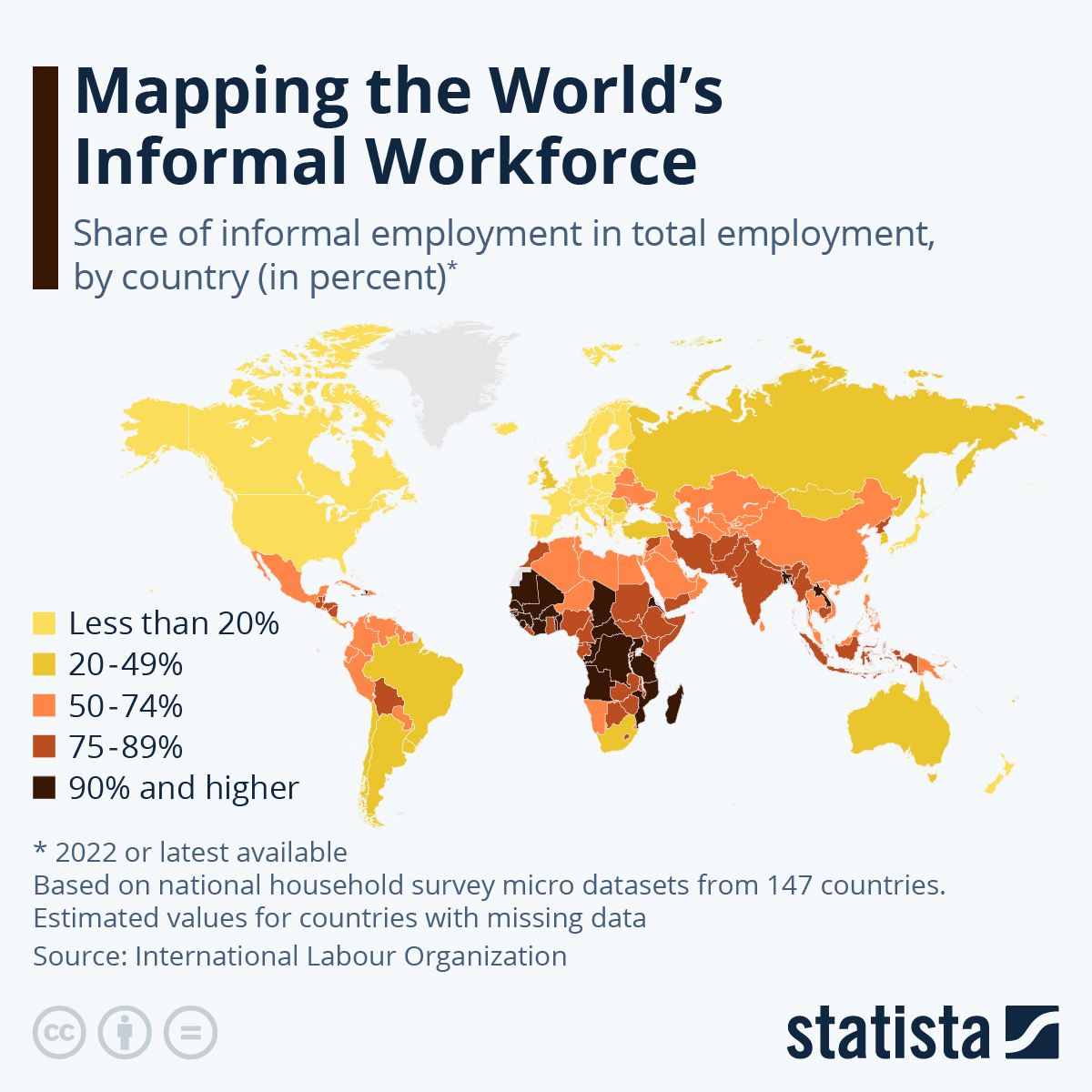
    India could not: Its ultra-hitech skills of a miniscule number found greener pastures abroad, while the low skilled had limited job opportunities in the public sector (which also shrank after a policy of deliberate divestment and privatisation by the present government.) The result has been a burgeoning informal sector, and impoverishment of the poor while the richest grow richer, as a recent ICE survey revealed:

    This depletion of a generation worth of human capital is unrecoverable and it means that India will not have a seat at the table in the emerging multipolar world order – witness its already diminishing clout in multilateral fora like SCO and BRICS+. Therefore, with the ideal of EQUALITY now firmly beyond our reach, the word SOCIALIST in the Preamble has become rather redundant.

    And what about Fraternity? Hasn’t that also remained unattainable in a society riven by caste and class and with a bloody history of riot after riot in its 75-year history? India has consistently failed to act in a secular way either by the standard definition of separating State and religion, or by its own version of secularism as the State acting neutrally between religions. Not when every political party in every election plays the ‘caste and community’ card right from the selection of candidates, to the design of campaigns and even the targeting of welfare schemes.  Which begs the question: what is secular about the Government’s calculus that we need that word in the Preamble?

    Globally, too, both these words are falling into disfavour: The collapse of the Soviet Union put paid to Socialism, and today, strident religiosity is rife everywhere – whether it is a Prime Minister justifying a genocide by referring to a 3000-year-old battle with the Amalek, or the Patriarch of Moscow, urging the Russian Army to take on Antichrist! 

    Yes, as someone who grew up in the heart of a compassionate society, I shall shed a silent tear when India does away with its socialist and secular aspirations; but so long as the other adjectives, SOVEREIGN and DEMOCRATIC, remain untouched, I shall be back here to celebrate the ONE Book which unites us all.

    Jai Hind!

    Related Links:

    The 3 Cs: Corruption, Clientelism and Capture

    Formalising the Informal

  • Our cities cannot be run just as businesses

    Published in Times of India, Pune in October 2018. Lost and found. Posted here for you.

    Very simply, large cities cannot be run as businesses because urban governance is more than just government. It is government + people. And while a business can clearly classify all its stakeholders (share-holders, management, workers, suppliers and distributors), how does a city draw the lines – between the property owners and the squatters? Between the tax-payers and the untaxed? Between the rich and the poor? Between the empowered citizens and the illegal migrants? Between the natives and the newcomers? Between the producers and the consumers? Between the governed and the government? Between local demands and regional priorities? 

    Thus, while a business can be satisfied with mere efficiency, a city needs to look at effectiveness. There is little merit in computerized property tax bills, if the tax base has not been updated for the last twenty years, is there? Ditto with completing a pumping station on time, if the water delivery continues to be erratic and unreliable. City dwellers are more interested in the water in their taps than in the technology which gets it there.

    Similarly, a business doesn’t really care about participationequity or inclusion while an urban government must necessarily provide for it.

    Accountability in business is often merely a matter of financial accounting and compliance with various government norms – if they were accountable to society at large, we wouldn’t need a law of torts, or liability clauses in every business contract. A city on the other hand, is held to account in every election by its citizens, and there are a large number of mechanisms available today, for citizens to monitor and pull up their local governments.

    These thoughts have come to mind as the citizens’ reactions to initiatives like AMRUT and Smart Cities are turning sour. Because they were (mis)led into believing that a little tweaking of software here, and a beautified road there would make them instantly more mobile and therefore more productive.  That has not happened. Instead, the mistakes of the erstwhile government’s JNNURM have been repeated in duplicate, with private consultants running the show and the State and Local bodies who are expected to execute, complete and maintain the various infrastructure projects, sulking in the sidelines as before. 

    The fact that the JNNURM then, and AMRUT now, are deeply influenced by organizations like the ADB explains this ‘cities as businesses’ approach, where a Business Development Plan got renamed as a City Development Plan, and almost all reforms made mandatory, had a financial angle – and somewhere along the line we forgot what a mish-mash the urban scene in India is, with thousands of small market towns, ancient pilgrim towns, bustling cities, and dysfunctional megacities with huge informal sectors, all getting the same treatment.

    Perhaps India needs to look at its BRICS partners for a lesson or two… Brazil had a similar experience, as the mayor of Sao Paulo admitted in an interview in 2013: “The previous economic model was very private-sector orientated, so the reaction of the local community was very negative. We need to rebalance the equation so development is not seen as a threat,” he said. “People consider politicians as bad people so it is important to get them involved personally. If they feel a sense of ownership then they don’t complain.” 

    So, the Brazilians took a different approach when preparing for the Olympics in Rio. They broadened the framework of a Smart City to include every aspect of the citizens’ lives: public safety, social programmes, healthcare, education, transportation, energy, water and the environment. And the tools used were smarter buildings and urban planning, and better government and agency administration. Only such a holistic approach which balances the human development, infrastructure and environmental aspects, and formulated with the active participation of the residents of a city, can make a city SMART in the long run.

    But who will convince the many IT consultants looking enviously at Songdo in South Korea or Masdar in the UAE, and hoping to create something similar in India? They don’t seem to realize that Indians may not really want this kind of super-efficient but impersonal urban experience. Nor that only a minute percentage could eventually afford to live in such a place! 

    Related:

    Good Governance

  • How we could resolve our growing Garbage Problem

    Published in Times of India, Pune on 1 May 2019. Lost and found. Posted here for you.

    According to the latest World Bank estimates, the world generates 2.01 billion tonnes of municipal solid waste annually, and global waste is expected to grow to 3.40 billion tonnes by 2050. Worldwide, waste generated per person per day averages 0.74 kilogrammes, but ranges widely, from 0.11 in the poorest countries, to 4.54 kilogrammes in high-income countries – which generate about 34% of the world’s waste, although they only account for 16% of the world’s population.

    Around the world, almost 40% of waste is disposed of in landfills. About 19% undergoes materials recovery through recycling and composting, and 11% is treated through modern incineration, while the remaining is openly dumped. More disturbing for the planet’s future is that at least 33% of the waste generated, is not managed in an environmentally safe manner.

    The most common form of waste collection across the world, is door-to-door. In this model, trucks or small vehicles are used to pick up garbage outside of households at a predetermined frequency. In certain localities, communities may dispose off waste in a central container or collection point where it is picked up by the municipality and transported to final disposal sites. In lower-middle-income countries like India, collection rates are about 51%. Improvement of waste collection services is a critical step to reduce pollution and thereby to improve human health and longevity.

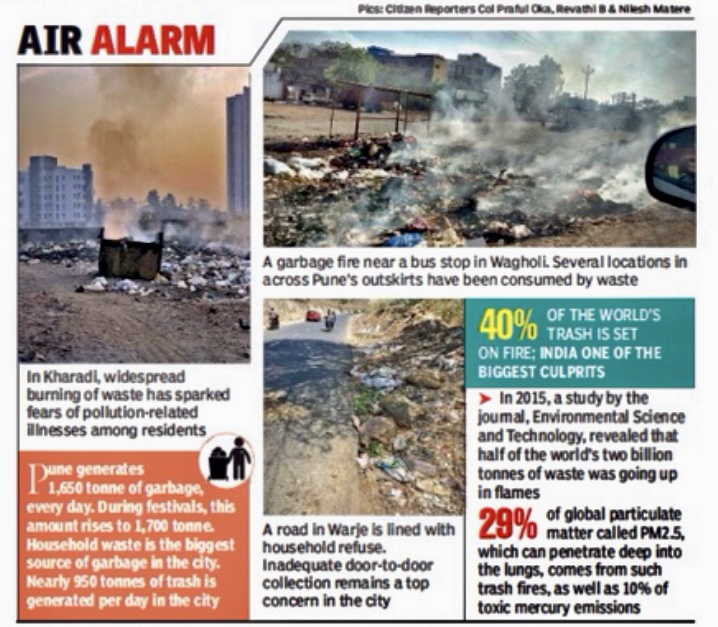
    The city of Pune in Western India generates 1600 -1700 tons of solid waste per day, with 160 trucks deployed to collect waste door-to-door. In addition to household waste, the bulk generators are construction and demolition waste, garden waste, and biomedical waste. 

    Pune Region has set up 200 material recovery centres, to reduce, reuse, recycle and recover 170 to 180 MT of plastic waste it generates per day, but 10,000 MT of e-waste per annum continues to pose a challenge. The downside of a green and beautiful Pune, is of course the huge quantities of garden waste generated – 60 to 70 MT per day – and a separate collection system is in place for collecting the waste, shredding it and transporting it to a centralised processing system.

    Waste disposal practices vary significantly by income level and region, and as nations prosper economically, waste is managed using more sustainable methods. Construction and use of landfills, is commonly the first step toward sustainable waste management. 

    The darker side of waste disposal is that richer countries often export their electronic waste to poorer countries and this e-waste contains toxic substances such as lead, mercury, cadmium, arsenic and flame retardants. Once in a landfill, these toxic materials seep out into the environment, contaminating land, water and the air, and harming the local community. In addition, devices are often dismantled in primitive conditions, and those who work at these sites suffer frequent bouts of illness, and long-term diseases.

    The ship-breaking yard at Alang in Gujarat is notorious for the chronic illnesses of its workforce, and is sardonically referred to as ‘Alang se Palang’ – death bed. On-site medical facilities at such places are either absent or totally inadequate. 

    The South Asia Region, where India is the largest country, generated 334 million tonnes of waste in 2016, at an average of 0.52 kilogram per capita daily, with 57% characterized as food and green waste. About 44% of waste is collected in South Asia, mainly through door-to-door systems, and three-fourths of waste is currently openly dumped, although improvements to collection systems and construction of sanitary final disposal sites are under way.

    It is estimated that basic solid waste management systems covering collection, transport, and sanitary disposal in low-income countries cost $35 per tonne at a minimum, and often much more. Systems that include more advanced approaches for waste treatment and recycling, naturally cost more – from $50 to $100 per tonne. 

    Almost all low-income countries, and a limited number of high-income countries, such as the Republic of Korea and Japan, subsidize domestic waste management from national or local budgets. The PMC sets aside 20.5% of Annual Rateable Value of one’s property as Conservancy Tax, in your annual property tax bill. Given that the base figure itself is often a gross undervaluation and seldom updated and all property taxes are non-buoyant, this amount is totally inadequate to cover the ever-rising costs of labour, transport, treatment and disposal. As a result, the local government has to depend on State and Central Government subsidies, and as with any subsidized service, the customer is never satisfied with the quality and adequacy of service provided. 

    Although public-private partnerships could potentially reduce the burden on local government budgets, the experience of such services in Indian cities has not been very encouraging.

    Thus, we are basically left with three options and some tough choices, if our cities are not to disappear in mounds of garbage:

    • Increase Fee collection – a move sure to meet with great resistance
    • Strengthen household waste collection systems by active collaboration of both the waste generators (at the housing society level), and NGOs or Collectives of professional waste collectors 
    • Decentralize the waste collection, treatment and disposal systems to Ward level. 

    Costs of Corruption

  • Independence Day 2023: On to true Freedom…

    As we celebrate another Independence Day in India, there will be a lot of chest thumping about the steadily growing GDP, reaching a record $3.75 trillion in 2023.

    However, the flip side is that the benefits of this economic growth are not reaching 75-85% of the common people, trapped as they are in India’s infernal informal sector.

    As a consequence:

    • The poverty rate in India has remained high, at 21.9% on the Multidimensional Poverty Index, and the number of people living in poverty is not declining
    • India’s Human Development Index has not improved significantly in recent years. In 2014, it was 0.629, and in 2022, it was 0.631 and the country ranks at 135/188 
    • Levels of Inequality are amongst the highest in the world. The richest 1% of Indians control more than 20% of the country’s wealth, while the poorest 50% of Indians control less than 10% of the wealth. The increasing inequality in India is not just of income and resources but also of opportunity, and as caste, class and birth continue to eclipse the opportunities available to an individual, the poor continue to remain poor as will their children and grandchildren. And continuing informalization will only deepen the divide between those who can and those who cannot

    The social effects of the growing informalisation of the economy are already visible:

    • Vast numbers of unemployed and underemployed youth are just waiting to be exploited by the rich and powerful to ignite an incident here, a rampage there, resulting in an increasingly unstable law and order situation
    • The decline in India’s manufacturing capabilities continues, where the trade deficit keeps inexorably rising, and domestic consumption is relegated to shoddy products manufactured in sweatshops in back alleys with no regard for quality assurance or labour welfare – leading to greater exploitation of the working class
    • The growing fatalism among the poor is very noticeable today, along with the total annihilation of protest movements, because the formal sector trade unions have been systematically eliminated following liberalisation
    • The increasing privatisation of primary, secondary and tertiary education and health care has eroded the very core of a welfare state that Nehruji evoked in his famous ‘Tryst with Destiny’ speech on 15 August 1947. This has not only nullified India’s demographic dividend, but will adversely affect the quality of its human resources for generations to come. 
    • The total politicisation of society, where even the most basic of human rights are bestowed as a ‘gift’ by the rulers and the subsequent subsidisation of basic needs, which creates the ‘dependency culture’ so noticeable in the declining years of all great powers. Moreover, workers in the informal sector are denied a feeling of self-worth and self-esteem and their only identity becomes an anonymous number in an indifferent identity system like Aadhar – which is at best a way to procure meagre benefits from an uncaring government, not a ticket to claim their rights as proud citizens of this country

    *               *              *

    The time has come this Fifteenth Day of August to revert to the original meaning of ‘Azadi’, which is not just independence but FREEDOM – a freedom from subservience, apathy, anomie, poverty, illiteracy, illness and the shackles of a burdensome past of grudge and grievance. 

    Happy Freedom Day to all!

    Related:

    Formalising the Informal

  • India’s cities are running out of water

    Published in Times of India, Pune in August 2018. Lost and found. Posted here for you.

    It may seem a little perverse to speak of a looming water crisis in the midst of heavy monsoon downpours, but the sad truth is that India’s water consumption is projected to touch 843 billion cubic meters (bcm) by 2025 against the current availability of 695 bcm. By 2050, the country will need 1,180 bcm of water, and at the same time groundwater is being depleted at unsustainable rates. These are the conclusions of a new report by the Niti Aayog, and its author, Avinash Mishra, goes on: “We’re in dire straits and we need to change our approach to tackle the crisis, otherwise the situation will become so grim that the shortages will knock down our GDP by 6 percentage points in over a decade.” 

    The problems begin with sourcing of water for big cities like Pune, Mumbai and Delhi. At the institutional level, urban local bodies do not have control of the source which is either with the Irrigation Department or parastatals like the Maharashtra Jeevan Pradhikaran, whose first priority is, naturally, agriculture. 

    Secondly, the groundwater of a city remains largely in private hands and is tantamount to theft, as the aquifers supplying water to private wells are a common natural resource for everyone. The Groundwater Surveys and Development Agency (GSDA) of the State Government has identified 4,500 wells in Pune, but only 200 borewells are registered with the PMC. The result of this discrepancy has been the growth of a tanker mafia, with the average Punekar at its mercy for his/her daily water supply. Again, only 150 water tanker suppliers are registered with the Corporation, while hundreds more operate below the radar – often tapping the PMC’s own supplies illegally, to sell at a premium to the hapless citizen.  

    To make matters worse, an estimated 70% of India’s water is contaminated with arsenic, fluoride, salinity, nitrates, industrial effluents, organic and inorganic solid waste. Further, only one-third of its wastewater is currently treated, meaning raw sewage flows into rivers, lakes and ponds – and eventually gets into the groundwater. Meanwhile, unchecked extraction by farmers and wealthy residents has caused groundwater levels to plunge to record lows, and 21 major cities will run out of groundwater by 2020, affecting 100 million people. 

    But a municipal corporation’s woes are only just beginning – having made this low-quality water drinkable at great cost in terms of treating agents and electric power for purification, it must further spend crores to distribute the treated water through an antiquated distribution network, losing further through illegal tapping and leakages in the system (PMC estimates the loss to be as high as 40%). The heavy physical losses, low pressure and intermittent supplies, lead to back siphoning and further contamination of water in the distribution network. 

    Of course, the consumer at the other end is never happy with the result, curses the Corporation for not providing water 24×7, and will take out morchas to protest even a 10-rupee hike in his monthly water bill. Water, it is argued, is a ‘gift of nature’ and should be free. In reality, the heavy subsidy on drinking water is the main reason for the impoverishment of municipal bodies the world over. The Pune Municipal Corporation, for instance, spends Rs 11 to provide 1000 litres of water, and recovers only Rs 5 – a subsidy of Rs 6 for every thousand litres, multiplied a thousand-fold, takes a heavy toll of its inadequate resources.

    The financial situation of municipal bodies was not helped by replacing buoyant local taxes like Octroi with grants from the Central kitty, routed and delayed by the State Government. It is estimated that although the Centre will compensate cites like Mumbai on par with their last receipts when Octroi was replaced by GST, the loss to the Corporation in terms of buoyancy and immediacy built into Octroi, could mean anywhere between 10-15% loss of revenue. The problem arising from the complexity of the institutional arrangements, the machinations of the informal water sector, and the huge imbalance between revenue and expenditure, all make urban water supply a city manager’s worst nightmare. 

    However, all is not lost – municipal bodies themselves can do a lot to improve operational efficiency in the sourcing and supply of water to their citizens. An effective, professional and dedicated workforce will go a long way in preventing the massive losses through illegal connections and leakages. The PMC has a permanent maintenance staff of only 1800 and must depend upon private contractors whom it can neither monitor, control nor regulate. This adds greatly to the inefficiency of the city’s water supply as a whole.  

    Demand side management of costing and pricing of water also needs to be modernised, learning from the good practices across the world. Currently, Pune has only 23% of its (mostly commercial) connections metred, but the bulk of its non-commercial users pay a lump sum as part of their annual property tax – and this has no relation whatsoever, to the actual quantity of water used in a year by that property owner. As the poor are limited in the amount of water they can store, the greatest beneficiaries of the subsidy are the middle class, who may indiscriminately use the expensively provided water for drinking, bathing, flushing their toilets, or washing their cars. While a more discriminatory pricing system like the Increasing Block Tariff or IBT will ensure that the available subsidies go to the deserving, the conservation of water through rainwater harvesting and recycling schemes could also be incentivised through a system of rebates on tariff. 

  • How to create empowerd Local Governments in India

    Published in Times of India, Pune, on 12 January, 2019. Lost and found. Reposted here for you.

    It would be amusing, if it were not sad – but every time one reads citizens’ demands or looks at the pictures sent by citizen reporters, one sees a limited obsession with just four things: garbage, potholes, traffic congestion and overflowing drains. The typical reader of our English press seems to believe that the Municipal Corporation is simply a recalcitrant and lazy servant, who collects a salary (property tax) from us and does nothing in return. Moreover, that money is either lost to corruption or in subsidizing the parasitic poor because they are captive vote banks.

    Nothing could be further from the truth.

    We Indians seem to have ingrained in our minds the image of the municipality as cleaners, scavengers, firefighters, recorders of births and deaths, and providers of water for men and cattle going back to Kautilya’s Arthashastra. The image of municipal officer as regulator got further exaggerated by the ‘kotwal’ mentioned in the ‘Ain-e-Akbari’ and of course the British formalized this image of local government in the mother of all municipal laws – the Bombay Municipal Act of 1888.

    This history has led to 3 major misconceptions among the formal sector or white-collar citizens of Indian cities:

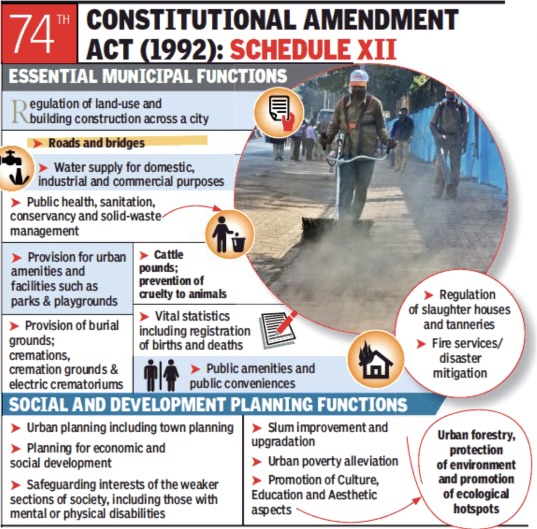
    Firstly, many believe that the Corporation merely performs a regulatory and conservancy role. This is not true. As seen from the box, the 74th Constitutional Amendment (1992) extended the role of urban local bodies to Development Planning, Poverty Alleviation and Social Sectors, under Schedule XII. But do we ever see our citizens mention the adequacy or inadequacy of a school or clinic in an area? Of course not. After all, the reader would never dream of sending her child to a municipal school, though her maid and driver will – because they have no choice! Never mind that the Pune Municipal Corporation (PMC) runs one of the poshest, entirely e-learning based schools in Sahakarnagar!

    Secondly, we the payers of Property Tax think we are bank rolling the Corporation’s annual budget. Far from it – believe me, the poorest woman is paying tax on every grain of salt she buys at the kiranawala (grocery) and part of it goes to the Municipal Corporation, earlier as Octroi, and now as the Goods and Services Tax (GST). And surprisingly, in the larger cities this indirect tax component is anything from 10-20% higher than the Property Tax collection.

    In the matter of subsidies, certain programmes for the poor are financed directly by Central Government or donor agencies, and others by State Government grants – not from local taxes. The most obvious local subsidy is on water supply (with the Pune Municipal Corporation spending Rs 11 and charging Rs 5 per 1,000 litres) but because of the indiscriminate pricing system, the biggest beneficiaries are not the hutment dwellers but people like us, with the luxury of huge storage tanks in our posh societies. 

    Thirdly, in the present dispensation, the local government is very limited in its activities and choices by various State Government departments and parastatals. For instance, it is the State Motor Vehicle Department which makes big money from an unbridled registration of new vehicles, but it falls to the Local Government to provide parking and roads. Similarly, while parastatals like MSRDC may construct flyovers, their subsequent upkeep is a burden on local government, even though they had no say in the quality of the original construction.

    Even the supply of water released to a city is controlled by the State Irrigation Department, and Corporations are charged commercial rates for power installations by Electricity Boards, even when used for street lighting in public spaces. Moreover, even the most senior level local employees of a Corporation ultimately report to Officers from a Central Service, posted by a State Government for a period of three years or less, with no historical memory of the city’s past, nor long term interest in the city’s future. So much for Local Government autonomy.

    Of course, we the citizens are not doing our bit to make the city liveable. With a middle class which considers individual mobility from the age of 16 a birth right, the congestion of private vehicles on our roads is inevitable – and when the pollution caused by these vehicles reaches Delhi levels, we will, of course, blame the municipal authorities. Ditto with garbage. How many housing societies start off with earnest vermicomposting, only to abandon it in a month, as all the composting worms have died because the wet garbage fed to them had bits of indigestible plastic?

    And how long do we care about maintaining our rain harvesting systems? Nobody knows how effective the collection is every monsoon, but we do crib about the PMC not giving us the 5% tax incentive in every Society AGM. In fact, all it takes is a visit to the nearest Cooperative Court to see the huge number of cases resulting from squabbling among members of Cooperative Housing Societies. This is the ONE chance at self-government we were given – and look at the mess.

    It is not this writer’s case that urban local bodies are the exemplars of every virtue. Only that instead of complaining about the shortcomings of the present system, we need to fight for systemic reforms – the Constitution of India provides us with the tools of transformation. All we need is to use our votes to push State Governments into taking our cities seriously and empowering our Local Governments and devolving the necessary resources and manpower to make them viable.

  • Development Plan remains only on Paper

    Published in Times of India, Pune in 2018, Lost and found. Reposted here for you

    We often read in papers about the DP or Development Plan of a city but barely 2% of us know what a DP is. The Development Plan of a city is its vision. It sets the agenda of what the city wants to do with itself in the next two to three decades. It takes into account the various public requirements of the city and reserves lands, whether public or private, for those purposes. The plan also proposes conservation and preservation of areas that have natural, historical or architectural importance.

    There are two instruments of a Development Plan – Zoning, and Reservation.

    ZONING is the means whereby compatible land uses are grouped together, and incompatible uses segregated – such as manufacturing industry and residential areas. RESERVATIONS for public purposes means reserving space for schools, colleges and educational institutions, medical and public health facilities, markets, social welfare and cultural institutions, theatres and places of public entertainment, religious buildings, government buildings, open spaces and playgrounds, natural reserves and sanctuaries, dairies, sites for public utilities such as water supply and sewerage, fire stations, other community sites, service industries and industrial estates. 

    The Development Plan also makes provisions for the city’s transportation and communication system such as roads, railways, airways and waterways, and parking facilities.

    In order to successfully implement the Development Plan, the municipal body needs to be empowered and this is done through Development Control Rules (DCR). These rules deal with the manner in which building permission can be obtained, the general building requirements, and aspects of structural safety and services. Access, layouts, open spaces, area and height limitations, lifts, fire protection, exits and parking requirements are all stipulated in the DCR. 

    Similarly structural design, quality of material and workmanship, and inspections during construction are also spelt out. The control of floor space use, tenement densities, and the Transfer of Development Rights are some of the most crucial issues dealt with by the rules. These rules are also framed by the planning authority and are sanctioned with suitable changes by the State Government.

    Although Development Planning is the path to city development all across the world, the sad fact is that in most Indian States, not even 10% of a DP gets actually implemented. This is because while the planning takes place at the State level, the implementation is left to the municipal body, which has limited resources to acquire land to implement various schemes. Local Governments are also preoccupied with meeting the daily needs of citizens and have neither the expertise nor the personnel for long term planning.

    As a result, people go in for new construction in areas where the Development Plan has promised infrastructure which may never materialize, and the beleaguered municipal body then has to ‘retrofit’ the area with these facilities at ten times the original cost. Perhaps greater involvement and participation of the affected citizens in the planning process, from the beginning, may be the best solution to the growing problems of underserviced urban sprawl in Indian cities.

    Related:

    Indian Urban Planning in Limbo